UNDER CONSTRUCTION — WORK IN PROGRESS
This page forms part of a developing public proof of concept. Content, structure and illustrations may change as the project develops.
WORK IN PROGRESS — THE BOOK
The Book
Rewiring the Public Sector: Closing the Circuit on Orphaned Outcomes
The challenge is not simply to digitise the state. It is to understand the state as a system.
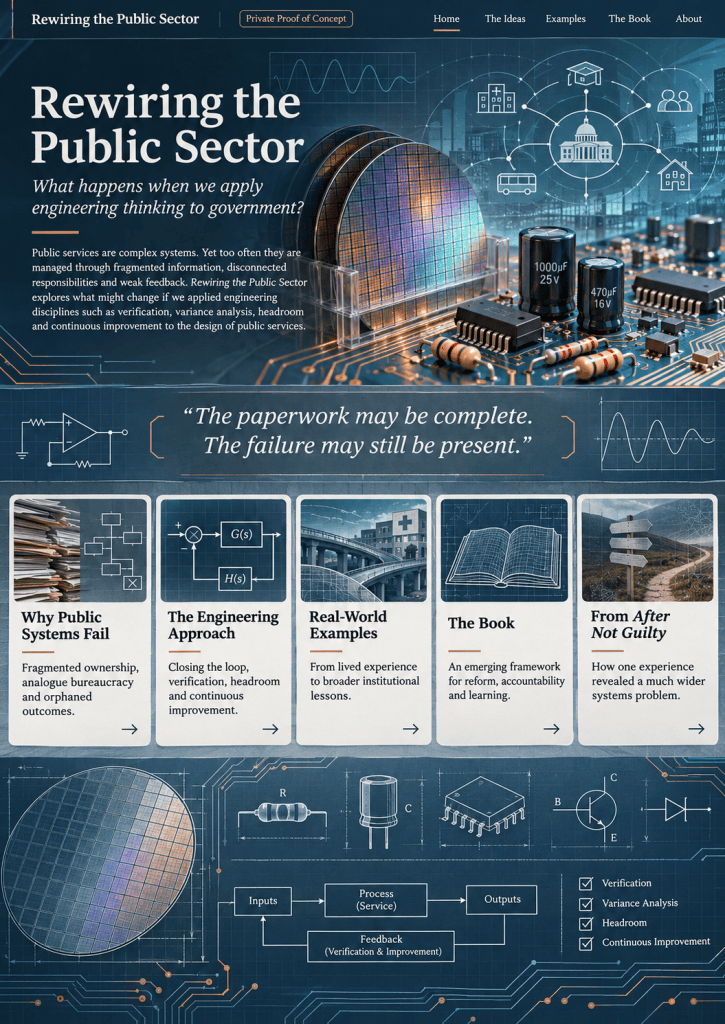
Rewiring the Public Sector examines public administration through the practical language of systems engineering and quality management. Its central concern is not whether individual organisations can demonstrate compliance with their own procedures, but whether the complete system produces coherent outcomes, assigns ownership, corrects defects, restores people where appropriate and learns in a way that can be verified.
The book begins with one apparently small event and follows the consequences outward. The personal case is the entry point and test case, not the whole book. From there, the argument widens into information integrity, institutional interfaces, accountability, resilience, AI, learning and the design of public systems.
What makes the book different?
Experienced engineering thinking
The book draws on decades of practical experience in electronics, power electronics, quality disciplines, technical sales, manufacturing supply chains and organisational change.
First principles
It does not begin with management fashion. It asks what the system is meant to achieve, how information moves, where responsibility sits and how outcomes are verified.
Real-world evidence
Case studies are used to reconstruct systems and test the method, not simply to decorate an argument.
AI comes after system understanding
The book treats AI as one component within a socio-technical system rather than the starting point for reform.
Don’t digitise the failure. Understand the system first.
The publisher storyboard
The existing publisher storyboard presents the approved front cover and the sequence of 24 chapter-opening illustrations. Each pairs an image with the chapter’s central question and the argument it advances. The selection below shows how that visual argument develops; the complete working chapter outline follows.
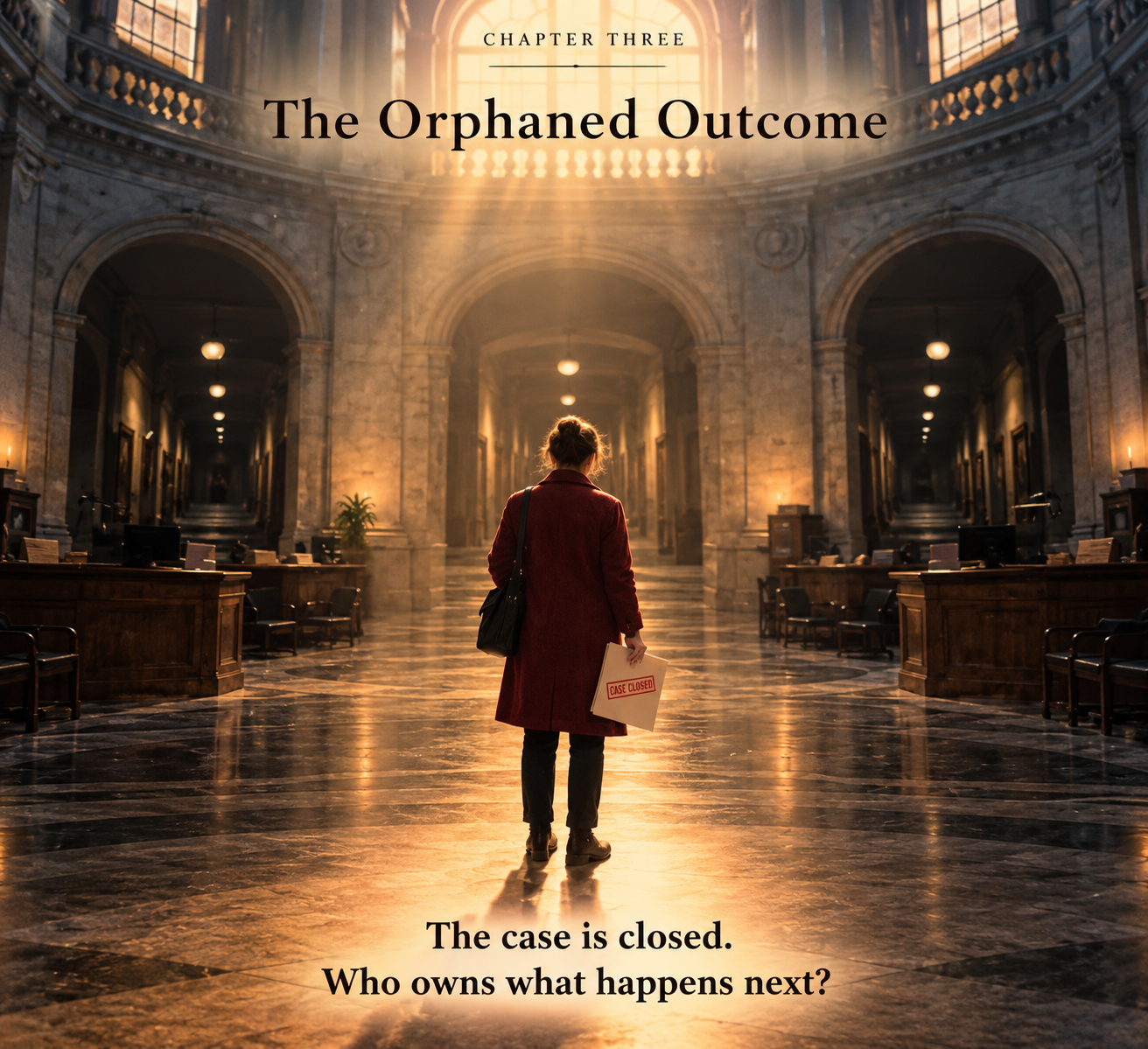
03 — The Orphaned Outcome
The case is closed. Who owns what happens next?
The solitary figure in an institutional atrium introduces an authoritative outcome whose downstream consequences remain unresolved.

04 — A System Is More Than Its Components
Every part is working. Why isn’t the whole?
A broken coupling shows why local compliance cannot guarantee whole-system performance. The reader moves from the personal outcome to an engineering way of seeing.

08 — Signal Integrity
Sending a message does not complete the communication.
The wireless scene introduces the need to preserve information, establish receipt and understanding, and connect the signal to appropriate action.
Selected conceptual illustrations from the existing visual sequence. Historical imagery illustrates a systems question; it does not replace the chapter’s historical evidence.
The reader’s journey: encounter the failure, understand the system, follow the information, identify the failure modes, examine working alternatives and design the corrective loop.
The book is intended for interested general readers, public-service leaders, policymakers and practitioners seeking practical ways to improve institutional outcomes. It brings experienced engineering disciplines to the people, records, rules and organisational interfaces that make public systems work—or prevent them from doing so.
One connected argument
The current controlled architecture contains 24 chapters in six parts. The argument moves from a specific failure, through engineering ways of seeing, into information integrity, institutional failure modes, examples of what good looks like, and finally practical rewiring.
Part I — The Fault
- Eleven Seconds — the apparently trivial event that exposes a much larger systems question.
- Not Guilty — Then What? — what remains unresolved after the criminal question has ended.
- The Orphaned Outcome — the organising concept: an authoritative outcome without ownership of its downstream consequences.
Part II — Thinking Like an Engineer
- A System Is More Than Its Components
- From Log Tables to AI
- Root Cause, Not Blame
- Lessons Will Be Learned
Part III — Follow the Information
- Signal Integrity
- The Justice Information Audit
- The Record and the Narrative
- Disclosure — The Circuit Breaker
Part IV — Failure Modes
- When Nobody Looks Across
- Data Without Reconciliation
- Busy Fools
- Institutional Defensiveness
Part V — What Good Looks Like
- The Architecture Already Exists
- Case Studies in Closing the Loop
- Scale Is Not the Excuse
- The Scottish Post-Acquittal Standard
- Beyond Not Guilty — The Post-Court Resolution Service
Part VI — Rewiring
- From Analogue Bureaucracy to a Learning State
- Star Trek or Idiocracy?
- Designing for Headroom
- Closing the Circuit
Visual development note: all 24 chapter-opening illustrations have an approved visual sequence in the controlled publisher storyboard. Selected illustrations are displayed above; the full sequence remains the source for the publisher storyboard.
The method behind the case studies
Major case studies follow a consistent analytical pattern so that the reader learns the method as well as the facts:
Failure mode → What happened → Consequence → Control absent/present → Evidence of effectiveness → Application elsewhere
The book distinguishes what a source proves from what it merely illustrates, and separates judicial authority, official reports, inquiries, regulatory action, academic work, credible reporting and the author’s own propositions.
The recurring engineering vocabulary
- Orphaned outcome — an outcome without ownership of its complete downstream consequences.
- Open circuit — responsibility, information or corrective action terminates between organisations.
- Closed loop — the result of corrective action is fed back and its effectiveness verified.
- Signal integrity — information remains accurate and appropriately contextualised as it moves through the system.
- Circuit breaker — a control that stops an unsustainable or harmful process before avoidable consequences accumulate.
- Headroom / derating — capacity deliberately reserved so the system can absorb shocks and adapt.
- Restoration — reconciling consequences with the authoritative outcome and returning the affected person, as far as appropriate, to the position that should follow.
Where the argument ends
The final part returns from the wider public-sector argument to the citizen. Outcomes need owners. Corrective actions need verification. Restoration and learning are what finally close the circuit.
“Restoration is the point at which an orphaned outcome finally gets an owner.”
This is a working book architecture. Chapter wording, examples and placement will continue to evolve as the manuscript is written and evidence is tested.

